Tuesday, February 1, 2011

Signs Of Spring !

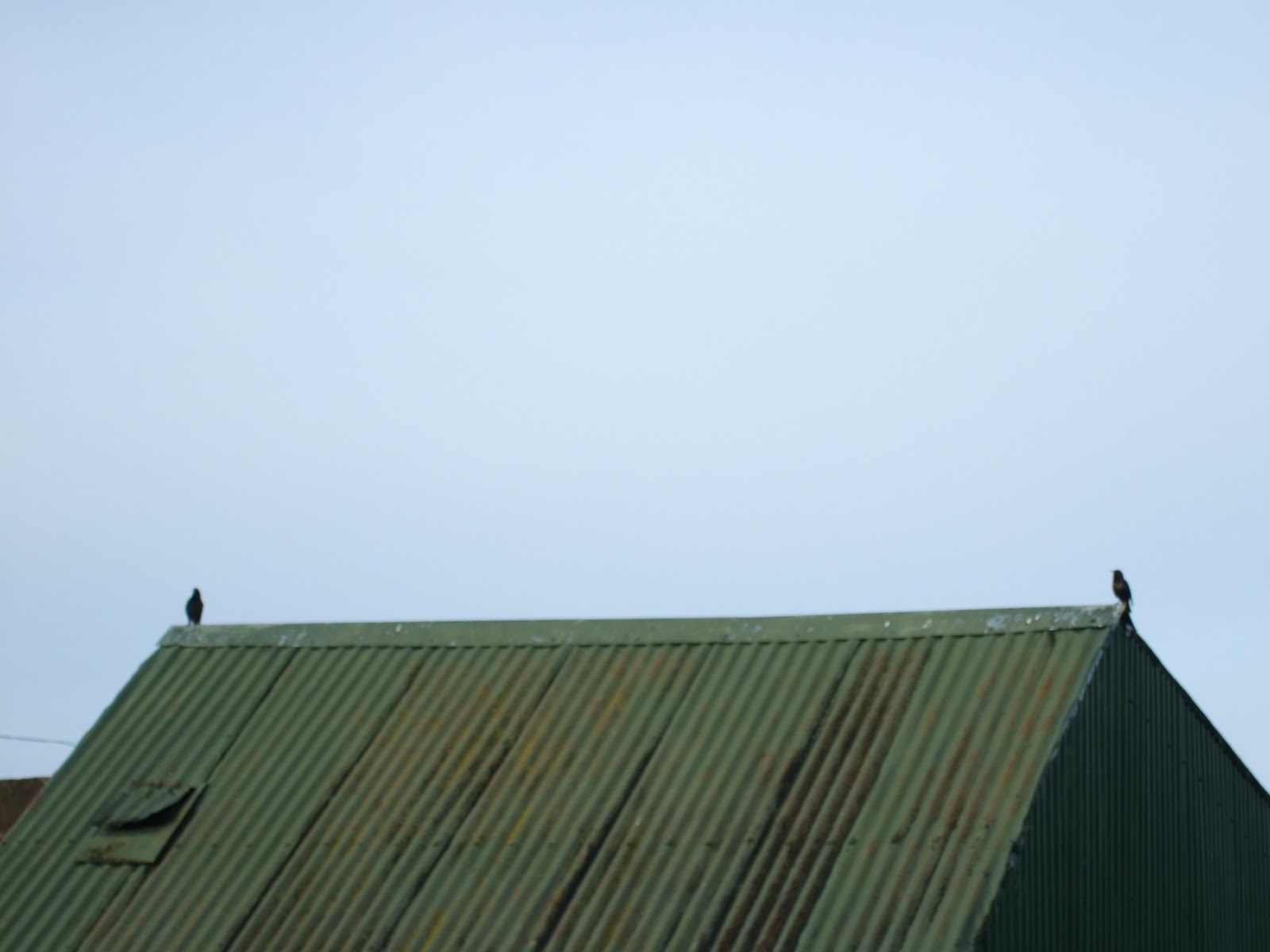
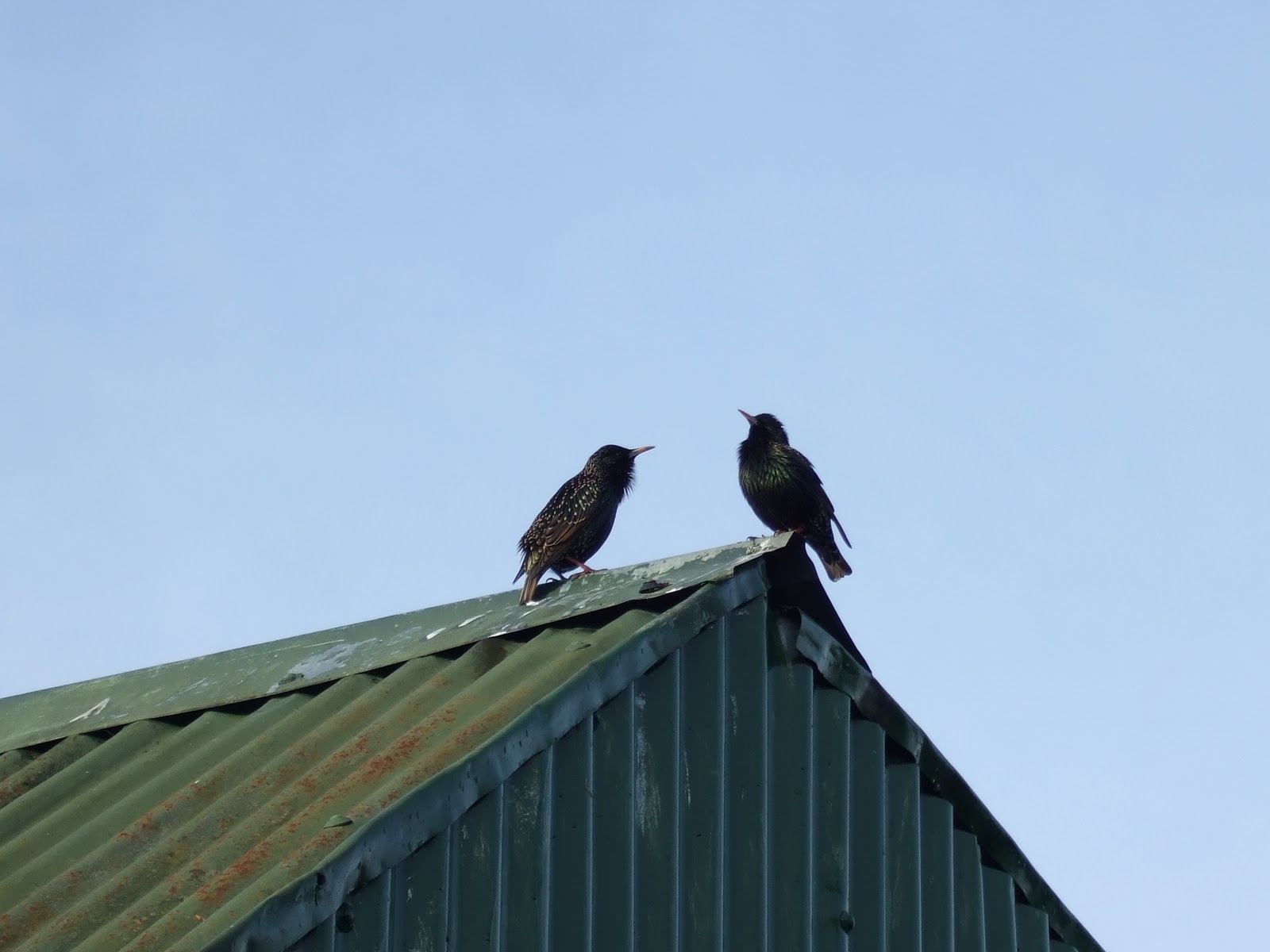
A beautiful day today and signs of Spring ,Snowdrops in flower,and one of my favourite birds the Starlings were bringing straws into a nest that they have been using for at least 40years.


These pictures were taken last year on 16/01/2010,they started out at opposite ends of the shed and gradually after much noisy courtship ended up together at the entrance to the nest.I don"t know how long they live, but only one pair nest here so how they decide its time to change tenants is a mystery  to me.They seem to raise two broods of 3-4 young and constantly amaze me with the amount of food they bring in all day every day,regardless of weather.The farm cats sometimes try their luck at catching them as do some magpies but after a lot of screeching are usually driven  of ,the magpies try to  lure the young out to the entrance to catch them and so far have not been sucessful as far as I know.
A very large "murmur" of Starlings have also spent alot of time this Winter feeding on one of the silage fields,they must eat grass because no  insects could have survived the low temperatures ,and constant "grazing of Lapwing,Redwing,Rook,Fieldfare and seagulls etc. 

Friday, January 14, 2011

Sexton beetle (not for squemish)

 As previously mentioned I sometimes run a mothtrap and more than moths turn up,flies beetles,caddisflies, etc,etc.Last June as I worked one a beetle with an atrocious smell arrived ,being covered in small brown mites it didn"t look to wholesome either.

Sexton beetle (Nicrophorous humator )

I identified it as a sexton beetle, so called because it buries dead birds and rodents before laying its eggs on it.It buries them to deny access to other carrion feeding species .When the carcase is buried it injects it with strong antibiotic solutions to slow down decay,then lays its eggs.The brown mites also have a role ,they feed on fungi that might speed up the decay and so the beetle doesn"t seem to mind transporting them from foodsource  to foodsource.It is also unusual in that it remains until the grubs hatch and will cull the numbers if too many survive and threaten the survival of all.It has evolved a way of concentrating the smelly fluids of the corpse which it uses to deter anything which threatens it .
A.M Massie a reknowned beetle hunter was conducting a bug hunt in the New Forrest when he found the body of a dead tramp,"You take the feet I"ll take the head" he called to his companion,they shook the corpse over a sheet laid out for the purpose ,several beteeles fell out and these are still to be seen in the British Natural History Museum labeled "Dead tramp.New Forest.A.M Massie . 

Sunday, January 9, 2011

Ladybird killer

On April 29th last I found this seven spot lady bird on a fence post
 ,it wasn"t moving and had a small brown cylinderical  object under it in a
cocoon of some kind.It was the pupa of a ladybird killing wasp.


Dinocampus coccinellae
The braconid wasp D. coccinellae injects its egg into adults of large
 ladybirds, especially the 7-spot. The eggs hatch into larvae which grow within
the ladybird but do not kill it. They emerge and build a cocoon below
the ladybird, attaching it to a leaf or trees trunk.They sever  the nerve endings
 to the ladybirds legs  and it starves to death, The larvae pupate here
before emerging as full grown wasps.  The living-dead ladybird may act as a
 defence form other predators.

  • 2010 was a very good year for ladybirds, numbers were up particularly
  •  in August September .2011 will probably have a big wasp surge s a
  • result.

Saturday, December 18, 2010

The BIGGEST fly I ever saw !


Last July while conducting my butterfly transect I encountered the biggest  fly I ever met,at first I thought it was just  an unusually large Noon day fly but it quickly became obvious that it was something else .
A visit to the reference books turned up Tachina grossa a tacnid fly,these prey on large hairy catterpillars on which they lay eggs, that hatch and burrow into the caterpillar eating it alive, leaving the vital organs till last so as not to kill it prematurely.

Wednesday, December 15, 2010

Uncommon Things

In 2010 I have found some uncommon things in the Horse and Jockey area.In June I found several Bee orchids at a site where I had previously seen them,so called because bees try to mate with the flowers and in so doing pollinate them,although they can self pollinate if bees don"t  show up.
A Bee Orchid (Ophrys apifera)27/06/2010

27/06/2010

I also found the Marsh Hellebourine another beautiful orchid.

On the 7/07/2010 I found the caterpillar of the Small Eggar moth which has only been previously found in the Burren, and earlier this year in Donegal.This caterpillar lives in tents in Whitethorn hedges and the moth flies January to March.

 Adelphocoris seticornis nymph

Adelphocoris seticornis adult

Later in July I photographed a shield bug I didn"t recognise ,it took a while but it has been identified as Adelphocoris seticornis ,a rare bug only previously recorded 3 times in the S E of the country.I found both adult and nymph stages so it is breeding on site.

The site also has Marsh Fritillary butterflies on site these have been covered in a previous blog report.
The site is small all these were found in an area of less than 100m x 100m of cutover bog.


Saturday, December 11, 2010

December Moth (Poecilocampa populi)

It was a tropical 6C last evening and I was surprised at the number of moths that surfaced ,5Wintermoths,the Mottled Umber posted already ,and my favourite the Decembermoth of which there were 3.

This is a large black moth with big antennae,that flutter about urgently before settling down.It is one of ten moths of the Eggar family .

Friday, December 10, 2010

Mottled Umber Moth

After the cold weather one mild night and nature recovers ,tonight we met several moths as we travelled the road (slowly due to unmelted ice) and on arriving home found this moth at the gable end yard light.
                                                         Its a Mottled Umber (Erranis defoliaria )a male (female is wingless),its flight period is Oct -Jan